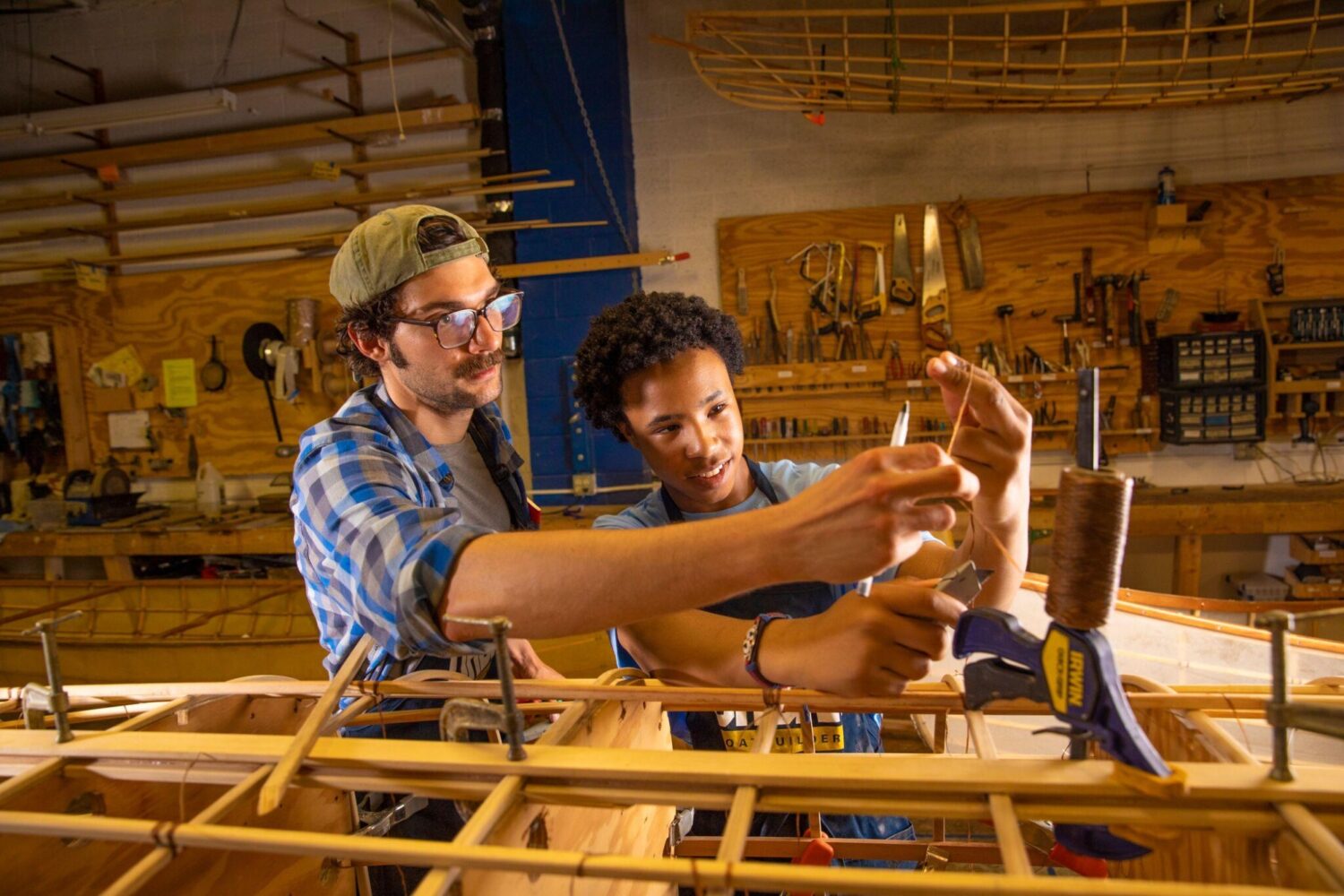
Urban Boatbuilders empowers youth to succeed in work and life through woodworking and experiential learning. In its Saint Paul workshop, young people ages 16 to 21 earn a paycheck while learning technical skills, and every apprentice arrives facing at least one barrier to employment. Demand has outpaced capacity for years, with roughly five applicants for every apprenticeship position — leaving the organization with priorities its board had endorsed and its staff of eleven had no room to pursue.
“Both of the projects that we’ve engaged with Compass on were things that we’ve talked about for a number of years and really wanted to work on,” said Executive Director Marc Hosmer. “Just with the limited staff capacity that we had, we didn’t have the ability to really dive in with the depth that was necessary.”
The first project, an On Track Strategic Alignment engagement, tackled career pathways. Apprentices were finishing the program with new skills but no clear next step. A team of six Compass Pro Bono volunteers mapped how the program was structured, researched comparable organizations, and met with employers across the community.
“They built some relationships there, and then they also created a structure — a way for us to put folks who are coming into the program new into a track so that we could effectively work with them to build the skills that they would need,” Marc said.
Urban Boatbuilders now builds an individual service strategy for every young person who enters the program, and maintains employer and training partnerships that give apprentices somewhere to go when they graduate.
The second project was more ambitious. Urban Boatbuilders wanted to launch a social enterprise selling handmade wooden goods: more paid work for youth, and revenue that did not depend on grants.
Through an On Track New Ventures project, a team of five Compass volunteers researched product opportunities, built cost and revenue models, and asked Twin Cities shops directly what they would be willing to stock. Then they did something the staff had not expected: they made the plan smaller.
“It felt like a much bigger thing to take on than we maybe had the capacity to do,” Marc said. “And the ‘aha moment’ was they put together a sort of a timeline and a strategy of: ‘Hey, just start with one product, start with two stores, let’s test this out, try it out, see how it works before you have to invest into staffing and all these other things that would go into it.’”
Urban Boatbuilders started with one product and two stores. Today, charcuterie and cutting boards made by young people in the workshop sell through local shops, and the revenue flows back into the program that trained them.
“It was hugely successful, and both of the stores that we worked with have reordered multiple times at this point,” Marc said. “So we’ve been expanding that program as a result of that start.”
The partnership also reshaped the board. Volunteers who spent months inside the organization kept showing up after their projects ended, and between project alumni and Compass’s board placement program, four current Urban Boatbuilders board members came to the organization through Compass — members who, Marc said, “have just added immensely to both the conversation, but also the work and the impact of the board as a whole.”
When asked what would have happened without Compass, Marc was direct. “Without access to Compass, I think it would have just been a very slow process, and we wouldn’t be anywhere near where we are today.” The teams, he said, “took on the bulk of that work. Their work moved us forward much more quickly than we would have ever been able to do on our own.”
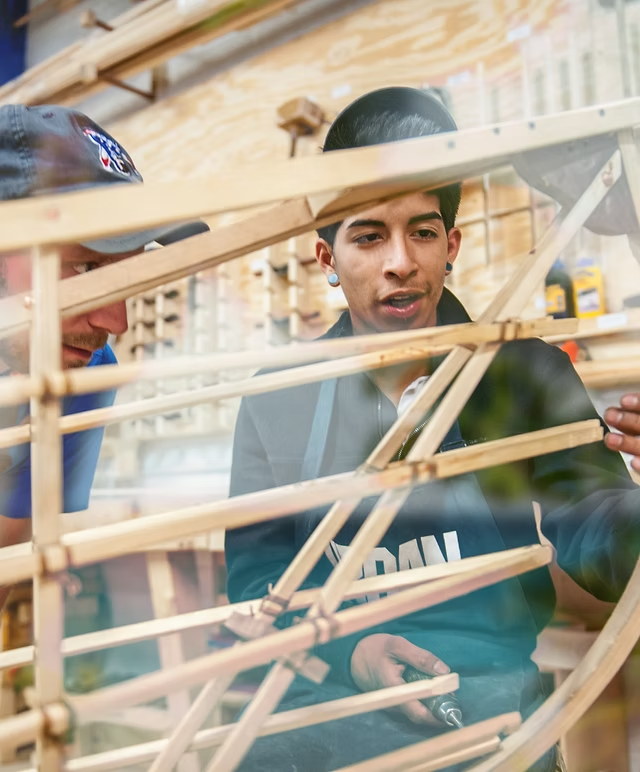
“The level of skill sets and experience that the volunteers come in with is just incredible. To have Compass make that all possible for nonprofits for free is just an incredible opportunity.”
Marc Hosmer, Executive Director of Urban Boatbuilders
Impact
Across two Compass Pro Bono projects, Urban Boatbuilders has:
- Launched a working social enterprise, with the program expanding since.
- Built a career pathways structure, including an individual service strategy for every apprentice and ongoing relationships with employers and training programs.
- Strengthened its board, with four current members connected to the organization through Compass.
- Received an estimated $157,000 in donated strategy consulting.